

Solar Panel Critter Guard & Bird Guard Installation in Connecticut
No-drill mesh that keeps squirrels and nesting birds out from under your solar panels.
A solar panel critter guard is a fitted mesh barrier installed around the open perimeter beneath rooftop solar panels to keep squirrels, nesting birds, and other small animals out of the gap between the panels and your roof. SolarWash CT installs no-drill critter and bird guard mesh across 26 towns in South Central Connecticut and Fairfield County, with installations starting at $800 — and before the mesh goes on, we clear what a leaf blower can move from under the panels ($50 when there's debris).
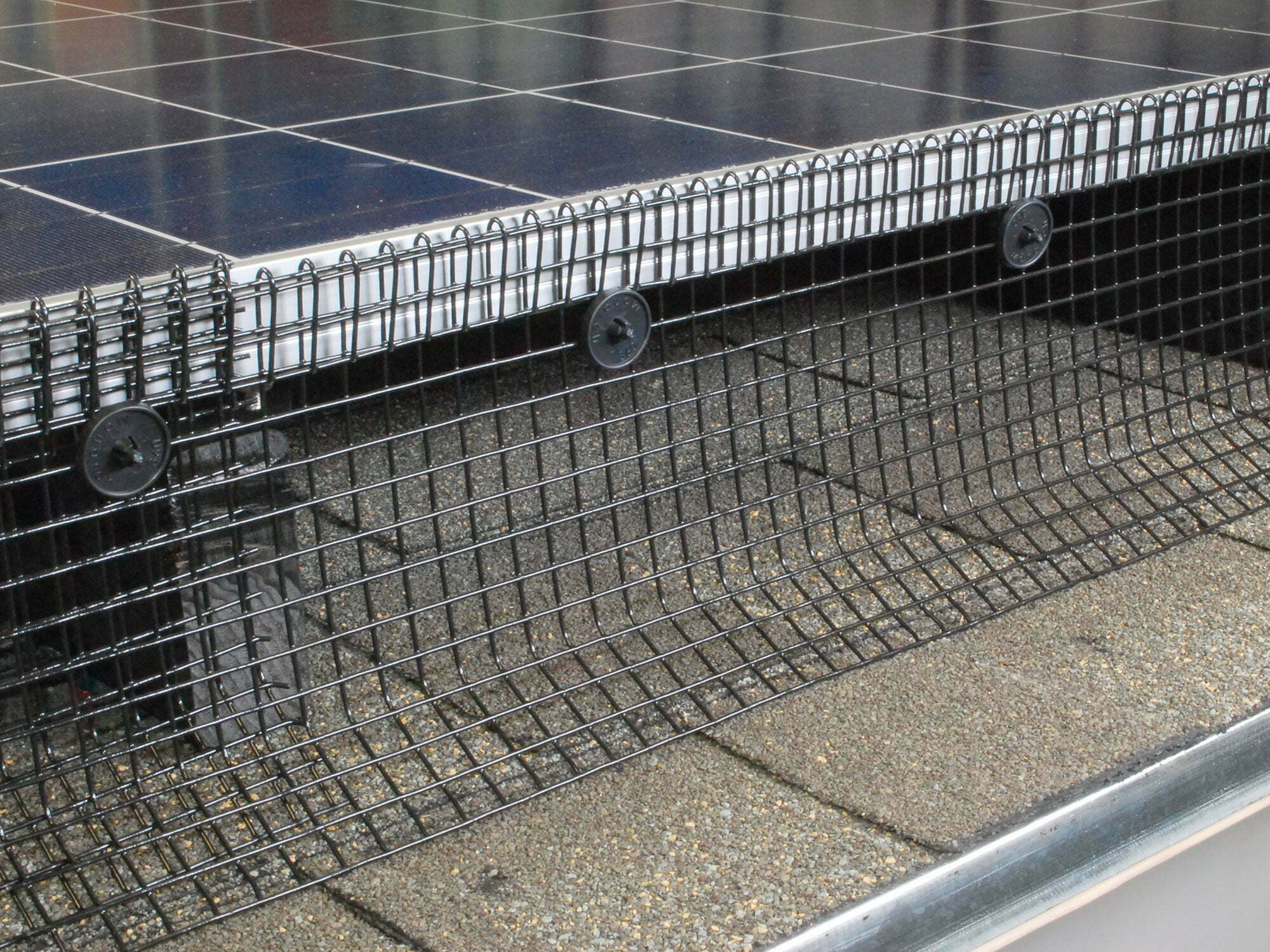
What is a solar panel critter guard?
A critter guard is a rigid, UV-resistant wire mesh that wraps the edges of your solar array and closes the 4–8 inch gap between the panels and the roof surface. Homeowners use several names for the same product — critter guard, bird guard, squirrel guard, solar panel mesh, and solar skirt all describe barriers that stop animals from getting underneath. Whatever you call it, the job is the same: block access while preserving the airflow and drainage your panels need.
Why do Connecticut solar panels need critter guards?
Because the space under a rooftop array is the best real estate in the neighborhood if you're a squirrel or a pigeon: elevated, sheltered from weather and predators, and warm. In Connecticut, eastern gray squirrels breed in late winter and again in summer — CT DEEP notes second litters commonly arrive in July — and birds nest under panels from early spring onward. Once animals move in, the damage compounds: chewed wire insulation, nests that dam water flow, droppings that soil panels and streak roofs, and in the worst cases arcing that becomes a fire risk. Read more about squirrels under solar panels in Connecticut.
Some panel warranties make this worse: certain manufacturers explicitly exclude animal damage from coverage, and panels from brands that have exited the solar business can be difficult or impossible to replace at all. Prevention is the only reliable protection for those systems.
How much does critter guard installation cost in Connecticut?
SolarWash CT critter guard installations start at $800, and clearing debris from under the panels is $50 when it's needed — we never install a guard over an active mess. Most installations run between $800 and $2,500. Final pricing depends on three things: the length of edge that needs mesh (the sides of the array cost more per foot than the eaves and top edges), the roof setup (a tall or steep roof takes more), and whether there is debris under the panels to clear.
For context, national estimates for professional critter guard installation run roughly $500–$2,000 (SolarReviews) to $500–$1,500 (NuWatt Energy, 2026) — those are third-party benchmarks, not SolarWash pricing. DIY mesh kits sell for as little as ~$40, but a bad fit that scratches panel frames, blocks drainage, or leaves gaps usually costs more to fix than a professional install. See our full critter guard cost guide for Connecticut.
What animals get under solar panels in Connecticut?
| Animal | Warning signs | Typical damage | Peak activity |
|---|---|---|---|
| Eastern gray squirrels | Scratching or pattering overhead, chewed insulation, shredded nesting material at panel edges | Chewed DC wiring, production loss, shorts and fire risk — wire repair calls commonly run up to $700 per visit (Boston Solar) | Late winter–spring breeding; July second litters; heavy fall activity |
| Pigeons | Cooing, dropping streaks down the roof, visible nest debris | Acidic droppings that soil panels and corrode surfaces, clogged drainage, output loss | Spring–summer nesting, year-round roosting |
| Small songbirds (sparrows, starlings) | Nests tucked at panel edges, constant bird traffic | Debris dams that trap water, mites and insects that follow nests | Spring |
| Raccoons (occasional) | Displaced flashing or mesh, larger disturbed areas | Dislodged wiring and components | Spring denning |
One documented UK insurance case (LV=) involved a single squirrel chewing through the wiring of 17 solar panels — this is not theoretical damage. If birds are the problem at your house, start with our guide to birds nesting under solar panels in CT.
A note on protected birds: many wild birds and their active nests are protected under federal migratory-bird rules. We assess before we exclude — see below.
What's included in a SolarWash CT installation?
- 1
Inspectionof the array, wiring, and the space underneath, with photos.
- 2
Lawful cleanup— removal of debris and inactive nesting material where appropriate ($50 when needed).
- 3
Measurementof the full panel perimeter.
- 4
Custom-fit, UV-resistant PVC-coated mesh, cut on-site to your array.
- 5
No-drill clip attachment to the panel frames only — we never drill into your roof or your panels.
- 6
Gap, drainage, and airflow check around the complete perimeter.
- 7
Before/after photo documentation delivered same-day with your written condition report.
Every job also gets a panel-brand check. Panels are electrically live whenever the sun is up, and several common Connecticut brands (thin-frame and legacy modules) need extra-careful handling — we document panel condition thoroughly before touching anything. Not sure what's under your array? A standalone solar panel inspection starts at $25.
Bird guard vs. critter guard — what's the difference?
They're the same product category; the names signal different problems. "Bird guard" is what homeowners search after seeing pigeons or nests; "critter guard" is the broader industry term that also covers squirrels — the animals responsible for most wiring damage. SolarWash CT installs one mesh system that handles both. For a deeper comparison including solar skirts and mesh types, see: Critter Guard vs Bird Guard vs Solar Mesh vs Solar Skirt →
What materials do you use?
| Component | Specification | Why it matters |
|---|---|---|
| Mesh | PVC-coated wire mesh, UV-resistant | Won't rust-streak your roof; typically lasts 15–20 years — the life of your panels |
| Fasteners | No-drill J-hook clips sized to module frames | No drilling, no roof penetrations, no voided roofing warranty |
| Fit | Cut-to-measure on site | Gap-free perimeter without blocking airflow or drainage |
One product, four names
| Term | What it blocks | Typical form | Best for |
|---|---|---|---|
| Critter guard | Squirrels, birds, and other small animals | Rigid wire mesh around the array perimeter | The broadest protection — the industry term for the full product category |
| Bird guard | Nesting birds and pigeons (same mesh) | Same perimeter mesh — the name signals a bird problem | Homeowners who first noticed nests or droppings |
| Solar panel mesh | Same animals — generic name for the material | PVC-coated or galvanized wire mesh | Describing the material itself |
| Solar skirt | Visual gap coverage; some animal exclusion | Rigid low-profile panels along the array edge | Aesthetics-first installs; less common in CT |
Will a critter guard void my warranty or hurt performance?
It won't hurt performance, and whether it affects your panel warranty depends on the panel manufacturer and installer. A properly installed guard never touches the panel glass and requires no drilling. The mesh sits around the perimeter of the array, so it can't shade cells or trap heat, and clip attachment means no penetrations in panels or roofing. If anything, guards help performance by keeping debris and droppings from accumulating under and around the array. Check your specific panel and roofing warranty terms; we're happy to review them with you before work begins — and if your panels are a brand whose warranty excludes animal damage, a guard is the only protection you have.
What if birds are already nesting under my panels?
We inspect before we exclude. If we find an active nest of a protected migratory bird, federal rules can require the work to be delayed, modified, or referred for appropriate wildlife handling before the perimeter is sealed — and we'll tell you that honestly rather than seal animals in or remove protected nests unlawfully. Inactive nests and debris are cleaned out as part of every installation. The best time to install a guard in Connecticut is before nesting season — late winter through early spring.
Can I bundle a critter guard with panel cleaning?
Yes — and most customers should. The mesh installation already puts us at your array, so a full deionized-water cleaning at the same visit saves you a second appointment, and Annual Maintenance Plan members save 15% on every cleaning visit. See residential cleaning →
Where does SolarWash CT install critter guards?
We install critter and bird guards throughout South Central Connecticut and Fairfield County: Wallingford (our home base), Meriden, Cheshire, Hamden, North Haven, New Haven, Durham, Middletown, Guilford, Madison, Branford, Milford, Orange, Woodbridge, Bethany, Middlefield, Clinton, Southington, and West Haven.
Recent Connecticut installations
Every installation gets before/after photos and a written condition report. Recent local jobs will appear here.
Frequently asked questions
What is a solar panel critter guard?
A solar panel critter guard is a fitted mesh barrier installed around the open perimeter beneath rooftop solar panels to keep squirrels, nesting birds, and other small animals from getting under the array.
How much does solar panel critter guard installation cost in Connecticut?
SolarWash CT critter guard installations start at $800 — most installations run $800-$2,500. Final pricing depends on the length of edge the guard covers, the roof setup, and whether there is debris under the panels to clear ($50). Free quotes are available across South Central Connecticut and Fairfield County.
Do squirrels chew solar panel wires?
Yes. Squirrels gnaw exposed DC wiring under solar panels and nest in the warm, sheltered gap between the panels and the roof. Chewed wires can cause production loss, system faults, and fire risk. A critter guard blocks access while maintaining airflow.
How does SolarWash CT install critter guard mesh?
SolarWash CT inspects and measures the array, cleans beneath the panels where appropriate, fits UV-resistant PVC-coated mesh around the panel perimeter, and secures it with no-drill clips attached to the panel frames — never drilled into the roof or panels.
Can a critter guard be installed on an existing solar panel system?
In most cases, yes. Critter guard mesh is custom-fitted on site to existing rooftop arrays after the system and the space beneath it have been inspected.
What happens if birds are already nesting under the solar panels?
The area is inspected before exclusion work begins. Active nests of protected migratory birds may require the work to be delayed, modified, or referred for appropriate wildlife handling before the perimeter is sealed.
Will a critter guard affect panel performance or void my warranty?
A properly installed guard sits around the array perimeter, never over the panel glass, and attaches with clips rather than drilling — so it does not shade cells or penetrate the roof or panels. Whether it affects your panel warranty depends on the panel manufacturer and installer, so check your warranty terms before the install.
How long do critter guards last?
UV-resistant mesh guards typically last 15 to 20 years — roughly the lifespan of the solar panels — and require no maintenance once installed.
Ready to protect your panels? Call or text (203) 659-0781, or get a free quote.
Last reviewed:
SolarWash CT — Wallingford, Connecticut. Owner-operated: the person you call is the person on your roof.
Ready to Restore Your Solar Panel Efficiency?
Free quotes for homeowners and businesses across South Central Connecticut and Fairfield County.